One operator. Any unmanned fleet.
DroneCommand™ is the command layer for heterogeneous unmanned systems: sovereign, post-quantum, European by design.
- National / EU / NATO SECRET cleared
- ISO 9001
- ISO 27001 (TÜV SÜD)
- NATO DIANA selected
- NSPA registered supplier
- NCI Agency member
- European supply chain

A unified command view for heterogeneous unmanned fleets.
AG-031
MULTIROTOR · Open autopilot
- ALT
- 138 m
- GS
- 3.1 m/s
- BAT
- 88 %
- LINK
- 93 %
- MODE
- AUTO / SUPERVISED
- CRYPTO
- ML-KEM · ML-DSA
- No events.
Interface simulation. Values are illustrative.
Keyboard: Space run/hold · 1 2 4 speed · + − zoom · F follow · 0 fit · ↑ ↓ select agent · T read telemetry
Fleets grew. Control did not.
Mixed fleets are already the norm. The software to command them is still sold one airframe at a time.
One fleet, five ground stations.
Each manufacturer ships its own control software. Operators switch screens instead of making decisions.
Vendor lock-in dressed as a platform.
Closed ecosystems force you to buy the airframe in order to get the software.
Foreign clouds, yesterday's cryptography.
Mission data leaves your jurisdiction, encrypted against a threat model that expires with the arrival of cryptographically relevant quantum computing.
Every asset is an agent.
Aerial, ground and static assets are described by one command model. The operator sees capabilities and tasks, not manufacturers and protocols.

Airframes are selected, integrated and validated on the bench before they become agents.
An aerial drone is an agent.
Fixed-wing or multirotor, any supported manufacturer. It publishes state, accepts tasks and reports results through the same command model as every other asset.
A ground vehicle is an agent.
Different physics, identical interface. Routes, waypoints and task handover are expressed once and resolved per asset class by the abstraction layer.
A static sensor is an agent.
Fixed installations contribute to the same situational picture and can trigger tasking for mobile assets without a separate console.
Hardware-agnostic is not a slogan. It is the architecture.
A hardware abstraction layer sits between the command layer and the vehicle. It is built on open standards and open-autopilot platforms, so the command layer never depends on an individual manufacturer's stack. Adding a manufacturer is an integration task, not a migration.
2–4 WEEKS
to integrate a new airframe type
| Asset category | Integration status |
|---|---|
| Multirotor · open autopilot | Supported |
| Fixed-wing · open autopilot | Supported |
| VTOL · open autopilot | Supported |
| Unmanned ground vehicles | Supported |
| Static sensor nodes | Supported |
| Docking and housing infrastructure | Integration on request |
| Proprietary manufacturer stacks | Assessed case by case |
The full compatibility matrix is available on request.
Software layer, or the whole system.
DroneCommand™ is hardware-agnostic by design. Deploy it over the fleet you already operate, or take it as an integrated system with airframes, ground station and communications supplied and validated by us. The command layer is identical either way. You are never locked into our hardware, and never locked out of it.
DroneCommand™ Software
Licensed per connected agent, any manufacturer. You supply the platforms; we supply integration for supported types and hardware abstraction development for new ones.
DroneCommand™ Integrated
MOST REQUESTEDThe command layer plus validated hardware: open-autopilot airframes, edge compute, datalink, ground control, and docking infrastructure where relevant. Delivered configured, tested and documented as a single system.
DroneCommand™ Programme
Certification support, sovereign on-premise and air-gapped deployment, lifecycle support under a defence or critical-infrastructure programme.

On-premise and edge deployments run on customer-controlled hardware.
Airframes are selected, integrated and validated by Decent Cybersecurity from open-autopilot platforms. Choosing the integrated system does not change the licensing model or the interfaces: the same abstraction layer, the same API.
Sovereign post-quantum AI.
The models that support the operator run where the mission runs, on the edge and on your infrastructure, not in a foreign cloud. Every link they touch is protected with post-quantum cryptography developed in-house. European code, European hosting, European legal jurisdiction.
On-premise, at the edge, or fully air-gapped. No dependency on non-European AI infrastructure, no telemetry leaving your network, no vendor subject to extraterritorial data obligations. Models are deployed and operated under our control.
Command, telemetry and agent traffic secured with NIST-selected post-quantum algorithms (ML-KEM, ML-DSA). Crypto-agile: algorithms can be replaced without touching the flight stack.
Autonomy assists perception, classification and planning. Flight control is independent by architecture. If the AI stops, the aircraft still flies, returns and lands.
Sovereign means: European jurisdiction, your hosting, an auditable supply chain, and no foreign remote access.
| Criterion | Typical non-European platform | DroneCommand™ |
|---|---|---|
| Hardware choice | Tied to the vendor's airframes | Any supported manufacturer, or ours |
| Data jurisdiction | Foreign cloud, extraterritorial reach | European hosting, your infrastructure |
| Cryptography | Classical algorithms only | Post-quantum, crypto-agile |
Autonomy with a documented limit.
Authority is expressed in three tiers. Every tier is configurable, logged and auditable, and the boundary between them is enforced in the command layer rather than in policy documents.
- TIER 1 · AUTONOMOUSLEVEL 1 / 3
Routine actions
Navigation, station-keeping, sensor sweeps, data relay and return-to-base run without operator input.
- TIER 2 · SUPERVISEDLEVEL 2 / 3
Confirmed actions
Task reassignment, area changes and classification acceptance are proposed by the system and executed only on operator confirmation.
- TIER 3 · HUMAN AUTHORITYLEVEL 3 / 3
Irreversible actions
Any action that cannot be undone requires explicit, logged human authorisation. No exceptions and no automatic escalation.
"Deciding that an object is hostile is always a human decision."
- No weapons integration.
- No autonomous engagement.
- No electronic warfare.
This is a procurement and compliance advantage. A system without engagement functions carries a narrower risk classification under the EU AI Act and a shorter path through internal review.
What happens when the link drops.
Degraded modes are designed, not discovered. Each failure removes capability without removing control.
The agent continues its authorised task, then executes a pre-agreed return or hold profile.
Navigation falls back to onboard estimation and returns along the last known safe corridor.
Tasking and logging continue at the edge and reconcile when the link returns.
Autonomy assistance degrades to manual and rule-based operation. Flight control is unaffected.
Agents complete or safely terminate the current task and hold under the standing authorisation policy.

Disconnected and field-forward operation is part of the design, not an exception.
What the platform work actually looks like.
Illustrative visuals of the engineering context around DroneCommand™: integration, delivery, degraded-mode operation, sovereign hosting and documentation.
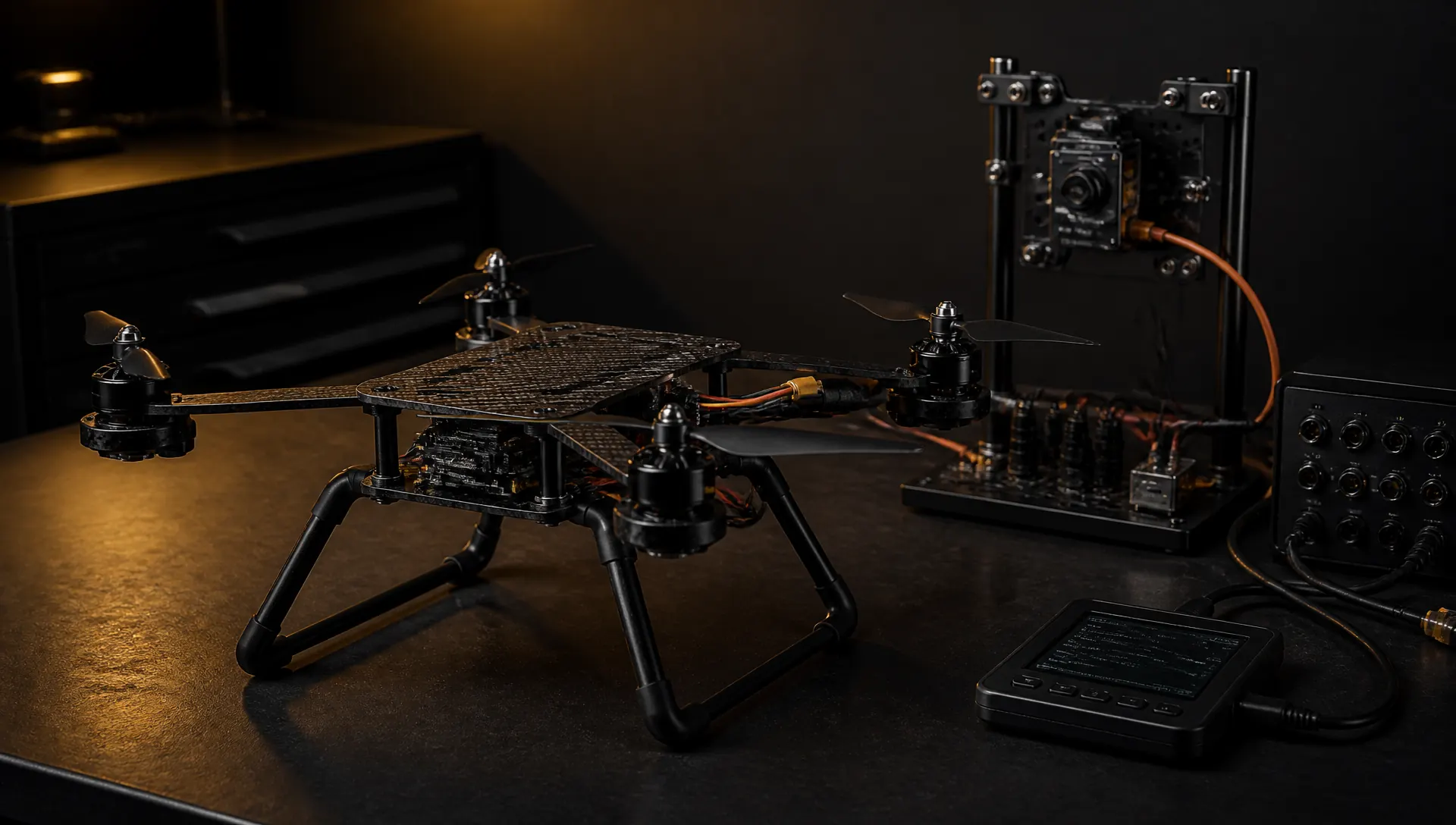
Integration bench Airframe onboarding
A candidate airframe on the integration bench. Airframes are selected, integrated and validated against the agent model; they are not manufactured in house.
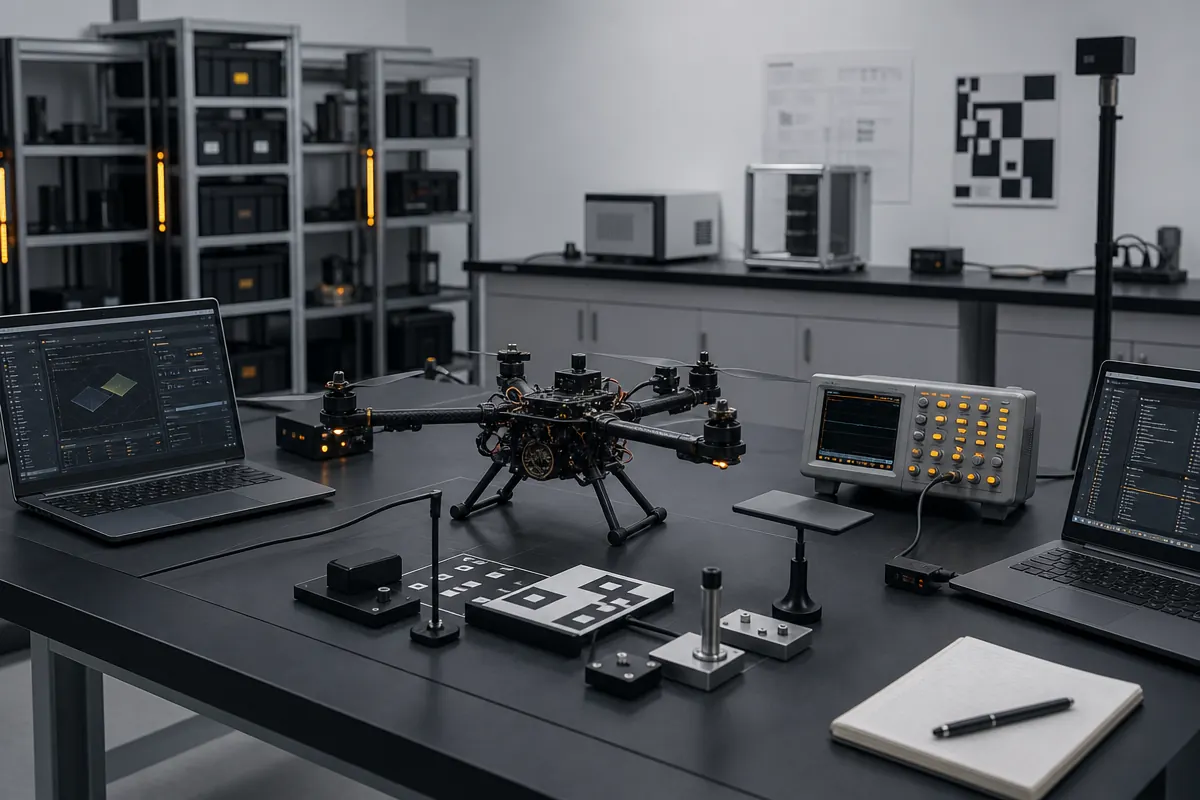
Protocol lab Driver validation
Bench work where a vendor protocol is mapped to a DroneCommand™ driver, then replayed against recorded telemetry until behaviour is deterministic.
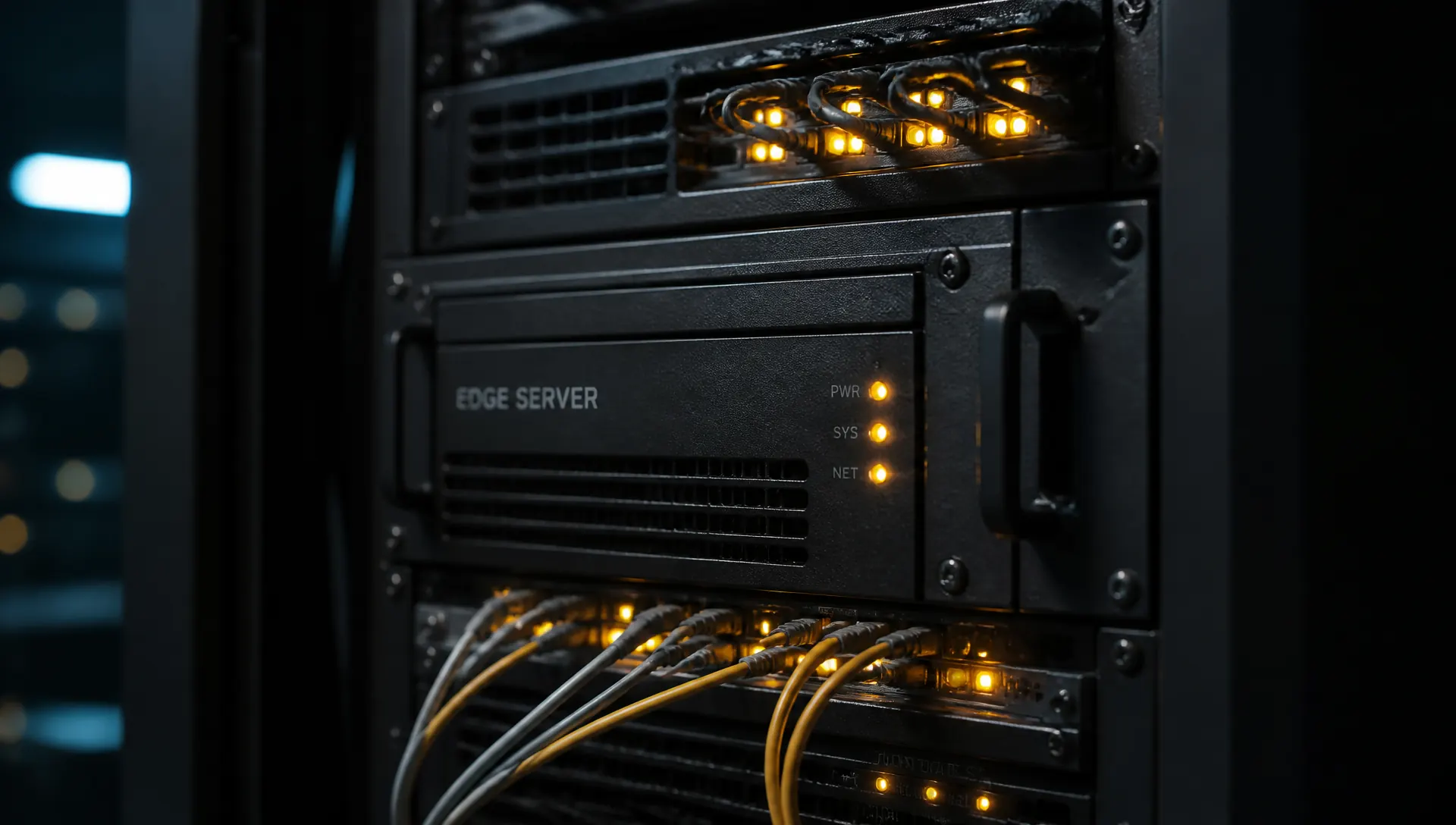
Delivery model Edge deployment
A ruggedised compute rack representing the on-premise delivery option, where the command layer and models run inside the customer perimeter.
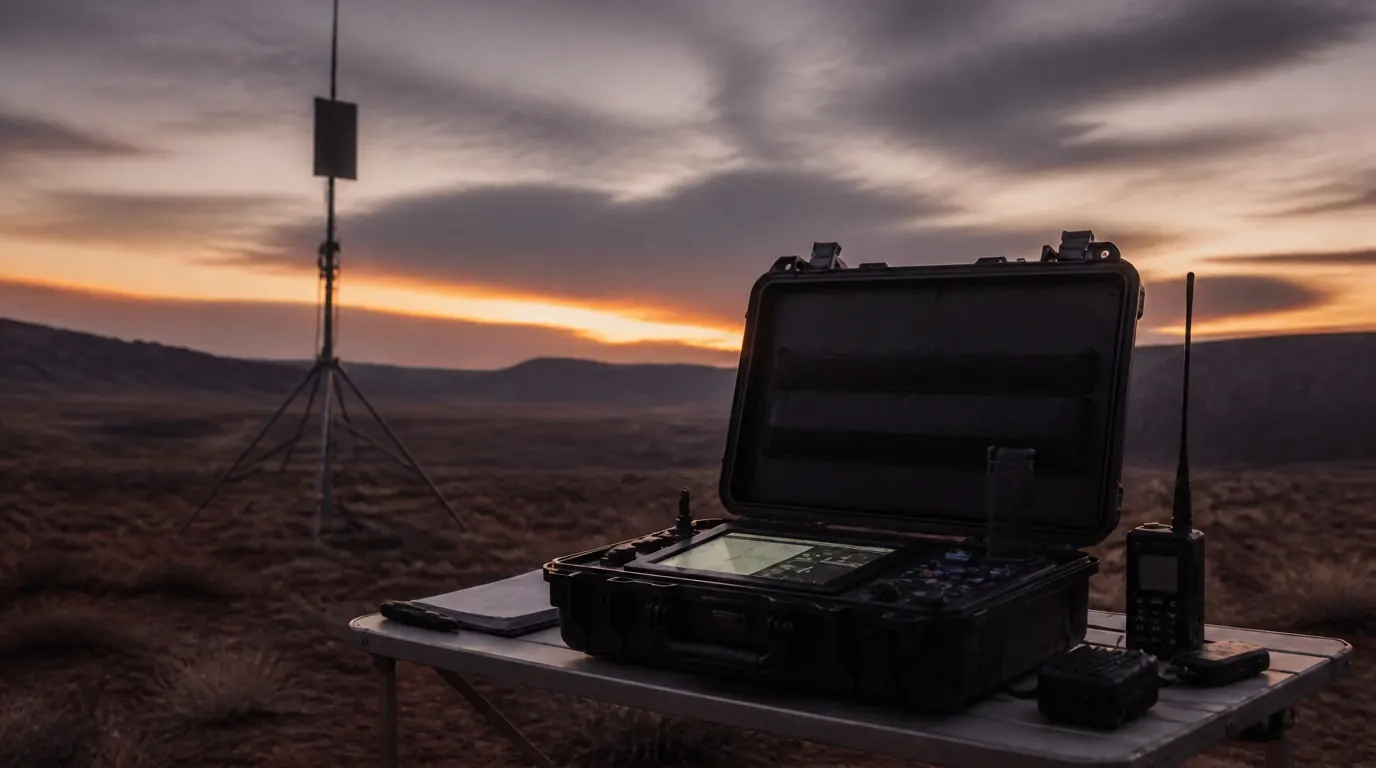
Degraded mode Field control
A field ground-control setup. The design intent is continued tasking when connectivity to the core is intermittent or absent.
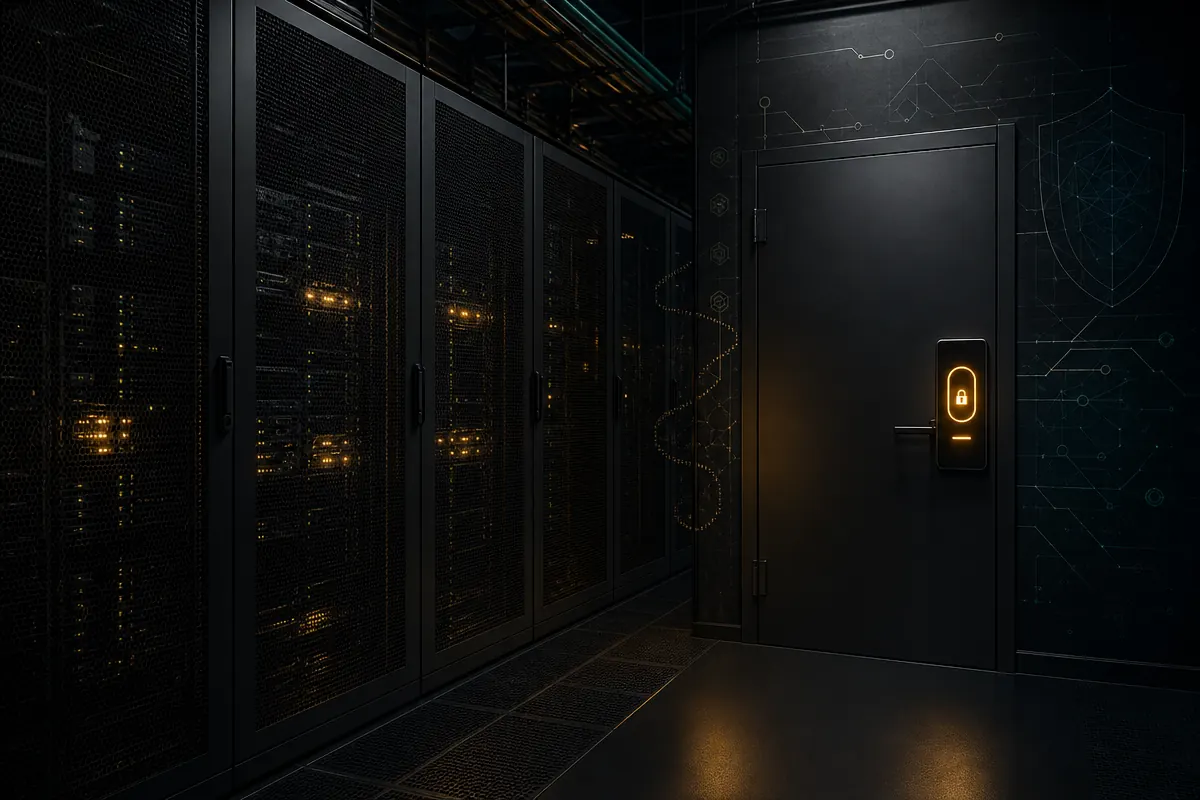
Sovereignty European hosting
Infrastructure of the type used for sovereign hosting: data, models and keys remain under the operator's control and jurisdiction.
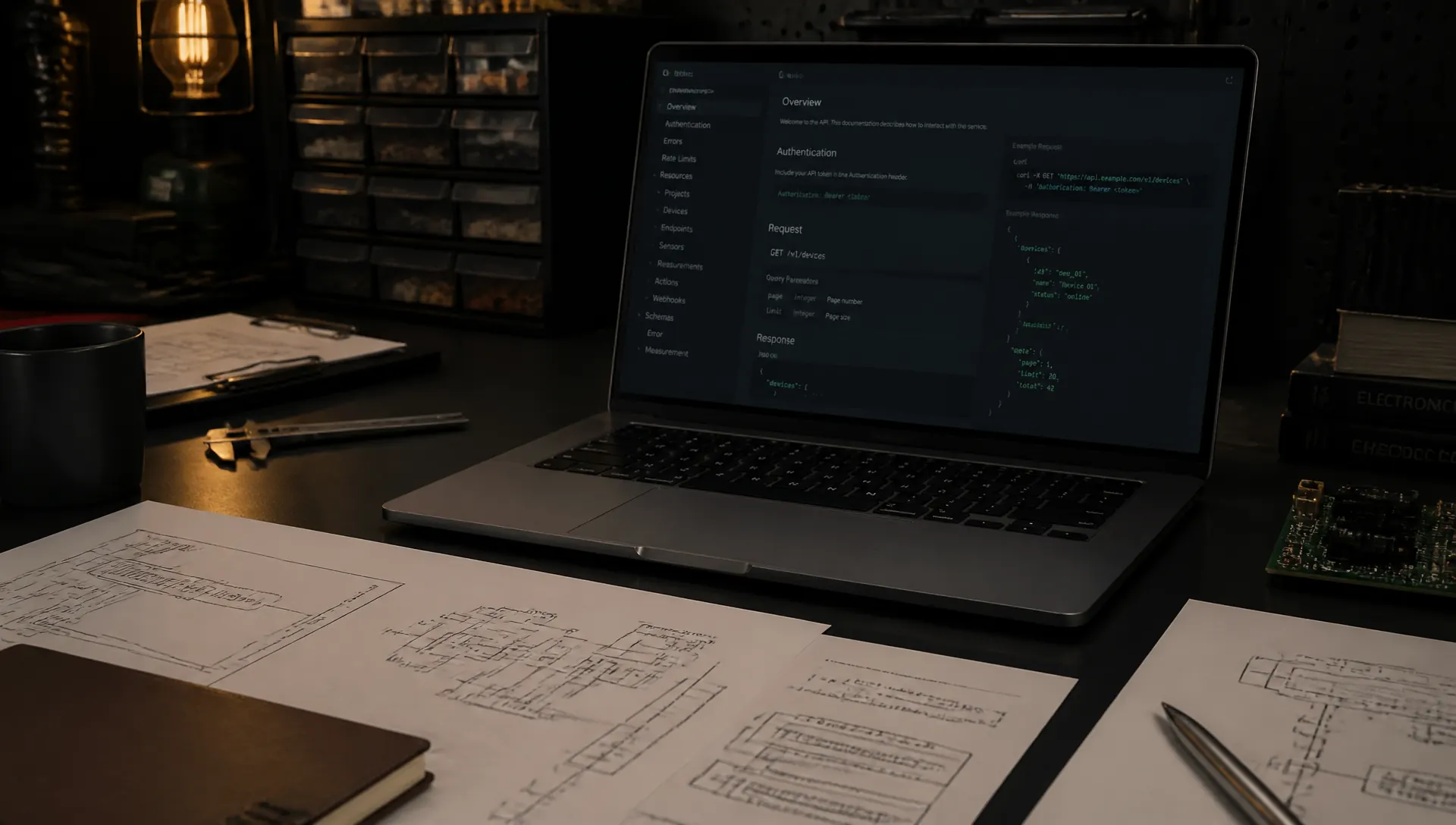
Documentation Engineering evidence
The documentation set is written alongside the platform: interface specifications, authorisation model and test evidence for technical review.


Procurement questions, answered plainly.
Licensing is per connected agent, independent of manufacturer. The same licence applies whether you bring your own platforms or take the integrated system. Request pricing for a written model.
Bring your fleet. Or let us bring the whole system.
Briefings are delivered under NDA. Technical deep-dives with our engineering team are available for qualified programmes.
Enquiries
business@decentcybersecurity.euInclude your organisation, country and area of interest. We respond to qualified enquiries and arrange briefings under NDA.